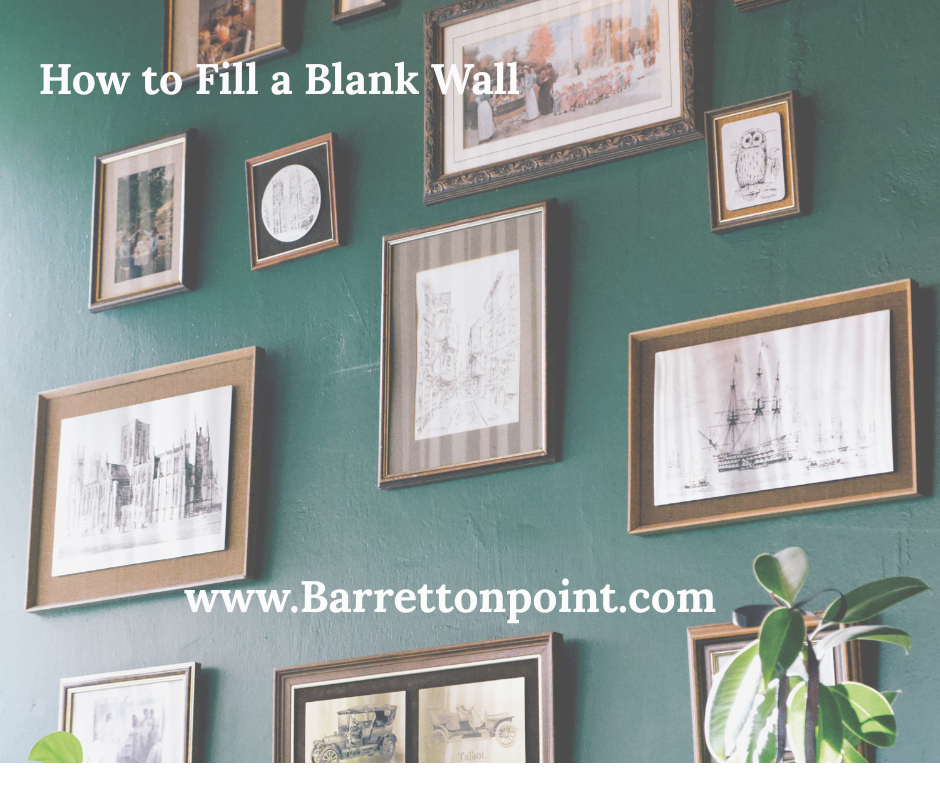
You know that wall.
Maybe it’s the big empty space behind the sofa. The awkward wall at the end of the hallway. The staircase you’ve been meaning to do something with for three years. Or the dining room wall that somehow still feels unfinished no matter what else you add to the room.
Blank walls can be surprisingly difficult to decorate—not because there aren’t enough options, but because there are too many.
Before you start buying frames or randomly hanging things, take a little time to figure out what the wall actually needs. A few simple decisions can make the difference between a wall that feels thoughtfully finished and one that feels cluttered or out of proportion.
Step 1: Look at the Whole Room, Not Just the Wall
Before deciding what to hang, stand across the room and look at the wall in context.
Ask yourself:
Is there furniture underneath it?
Is the wall already competing with a fireplace, television, windows or other focal point?
Is the room visually busy or fairly simple?
Does the space need more color, texture or warmth?
Is this wall large enough to make a statement?
Is it a narrow hallway, staircase or other awkward space?
Crate & Barrel recommends evaluating existing architectural elements and sight lines before planning a gallery wall. That same principle applies to almost any wall treatment.
The goal isn't necessarily to fill every available inch. Sometimes a blank area gives a room breathing room. The trick is identifying the walls that look intentionally open versus the ones that simply look unfinished.
Step 2: Decide What Kind of Wall You Want
Before shopping, choose a general direction.
One Large Statement Piece
This is often the simplest solution for a large wall over a sofa, console, bed or dining-room furniture.
A large painting, photograph, framed print or textile can create a focal point without introducing a lot of visual clutter.
One common decorating mistake is choosing artwork that's too small for the furniture beneath it. If you have a substantial sofa or console, a tiny picture floating above it will usually make the wall feel even larger.
And “large art” doesn't necessarily mean expensive art. Look for oversized prints, vintage pieces, framed textiles, printable artwork, estate-sale finds or even something you create yourself.
A Gallery Wall
Gallery walls work particularly well when you have several things you love but no single piece large enough for the space.
And they don't have to contain only photographs.
Try mixing:
Family photographs
Vacation pictures
Children's artwork
Paintings and prints
Vintage postcards
Maps
Handwritten recipes
Letters or meaningful documents
Small mirrors
Plates
Textile pieces
Shadow boxes
Small sculptural objects
Designers increasingly treat gallery walls as collections rather than simply rows of framed photographs. Mixing different mediums can give the display more depth and make it feel collected over time.
The secret is giving all that variety at least one connecting element.
That might be similar frame colors, a consistent color palette, matching mats, a common subject or simply repeating certain materials throughout the arrangement.
Step 3: Start With What You Already Own
Before buying anything, go shopping in your own house.
Pull out photographs you've never printed. Look through closets for artwork that hasn't found a home. Check drawers for old family photos, children's drawings, postcards or keepsakes.
You may already own the beginnings of a great wall.
This is also where decorating becomes personal. A perfectly coordinated collection purchased all at once can certainly be beautiful, but a wall containing pieces connected to your family, travels and memories tells a story that can't be ordered from a catalog.
Step 4: Fill the Gaps Without Spending a Fortune
Once you've gathered what you own, figure out what's missing.
You don't have to shop exclusively at home décor stores. Some of the best wall décor can come from unexpected places.
Try:
Facebook Marketplace
Estate sales
Antique stores
Thrift stores
Flea markets
Local artists
Printable art
Old books or botanical prints
Family photographs
Your kids' artwork
Fabric remnants
Vintage mirrors and frames
Don't dismiss a piece because you dislike its frame. A new mat, coat of paint or inexpensive replacement frame can completely change it.
Small artwork can also have much more presence when placed in a substantially larger frame with an oversized mat—a useful trick when you're trying to fill a large wall on a smaller budget.
Step 5: Think Beyond Pictures
Sometimes the answer to a blank wall isn't artwork at all.
If your room already contains plenty of framed pieces, introducing another material can make the space much more interesting.
Consider:
A mirror.
Especially useful in smaller or darker rooms because it reflects light and adds visual space.
Floating shelves or picture ledges.
Great if you like changing your décor. Lean framed art against the wall and layer it with books, plants and small objects rather than committing to one permanent arrangement.
Decorative molding.
Picture-frame molding, board and batten or other trim can make the wall itself the feature.
Wallpaper.
A full wall or strategically placed wallpaper can introduce pattern without requiring a collection of objects.
Textiles.
Vintage rugs, quilts, woven pieces and other textiles add softness and texture that framed artwork can't.
Baskets or plates.
Collections of dimensional objects can work particularly well in kitchens, dining rooms and casual spaces.
Functional décor.
Hooks, attractive shelving, pegboards or beautiful storage can turn an empty wall into useful space—especially in an entryway, mudroom, kitchen or home office.
Step 6: Get the Scale Right
Scale is one of the biggest reasons wall décor can feel “off.”
A huge wall doesn't necessarily require dozens of little objects. Sometimes it needs one or two larger pieces.
Likewise, a narrow wall may look better with a vertical arrangement than a wide horizontal one.
Before purchasing anything, use painter's tape to outline the approximate dimensions on your wall. Live with it for a day or two.
Walk into the room from different directions.
Does it look substantial enough?
Too big?
Too high?
This tiny step can prevent a surprisingly expensive decorating mistake.
Step 7: Plan a Gallery Wall Before Making Holes
If you're creating a gallery wall, resist the urge to start hammering.
Lay everything on the floor first.
Start with your largest or most important piece and arrange the smaller pieces around it. Move things until the overall composition feels balanced.
Take a picture of the arrangement with your phone.
Then trace each frame onto kraft paper, newspaper or other inexpensive paper and cut out the shapes. Tape those templates to the wall.
Now you can move the entire arrangement around without making a single hole.
Crate & Barrel recommends this paper-template method, and it's one of the easiest ways to visualize spacing and placement before committing.
Try to keep the spacing between pieces reasonably consistent. Even an eclectic collection looks more intentional when there's some visual rhythm holding it together.
Step 8: Don't Hang Everything Too High
This may be one of the most common decorating mistakes.
Artwork should relate to the people and furniture in the room—not hover near the ceiling.
A commonly used guideline is to position the center of artwork around eye level. Architectural Digest cites approximately 57 inches from the floor to the center of the piece as a useful starting point, although the furniture, ceiling height and particular room may call for adjustments.
When artwork hangs above furniture, also look at the entire grouping as one composition rather than treating the furniture and artwork as unrelated objects.
Step 9: Step Back Before You Decide It's Finished
After everything is up, leave the room.
Then walk back in.
Look at the wall from the doorway and from the places where you normally sit or walk through the room.
Something that looked perfectly balanced while you were standing two feet away with a hammer may look completely different from across the room.
You may need to remove something, add something or shift a piece.
That's normal.
A home doesn't have to be decorated perfectly—or all at once.
The Easiest Formula If You Still Don't Know What to Do
If you're staring at your wall thinking, “Okay, but just tell me what to put there,” start with one of these:
Above a sofa: One oversized piece, a pair of coordinating pieces or a substantial gallery wall.
Above a console: Art or a mirror anchored by lamps and accessories on the console.
Dining room: Large artwork, a mirror, gallery wall, plates or architectural molding.
Hallway: Family photographs, a simple gallery wall or a series of matching frames.
Staircase: A gallery wall that follows the angle of the stairs.
Bedroom: One large piece or two to three coordinated pieces above the bed.
Kitchen: Vintage art, food-related prints, plates, open shelving or personal pieces such as a framed handwritten family recipe.
Small awkward wall: Don't overthink it. A narrow mirror, small piece of art, wall-mounted planter or tiny collection may be all it needs.
One Last Rule: Your House Should Look Like You Live There
Beautiful homes aren't necessarily the ones where every frame matches and every piece of art coordinates perfectly.
They're the ones that tell you something about the people who live there.
Frame the funny photo.
Hang your grandmother's recipe.
Keep your child's artwork.
Buy the weird little painting you found at an antique store simply because you love it.
Your wall doesn't need to look like it came straight out of a catalog. It just needs enough thought and intention to make the room—and your home—feel a little more like you.